
There Never was a Traitor in the Country of the Blind
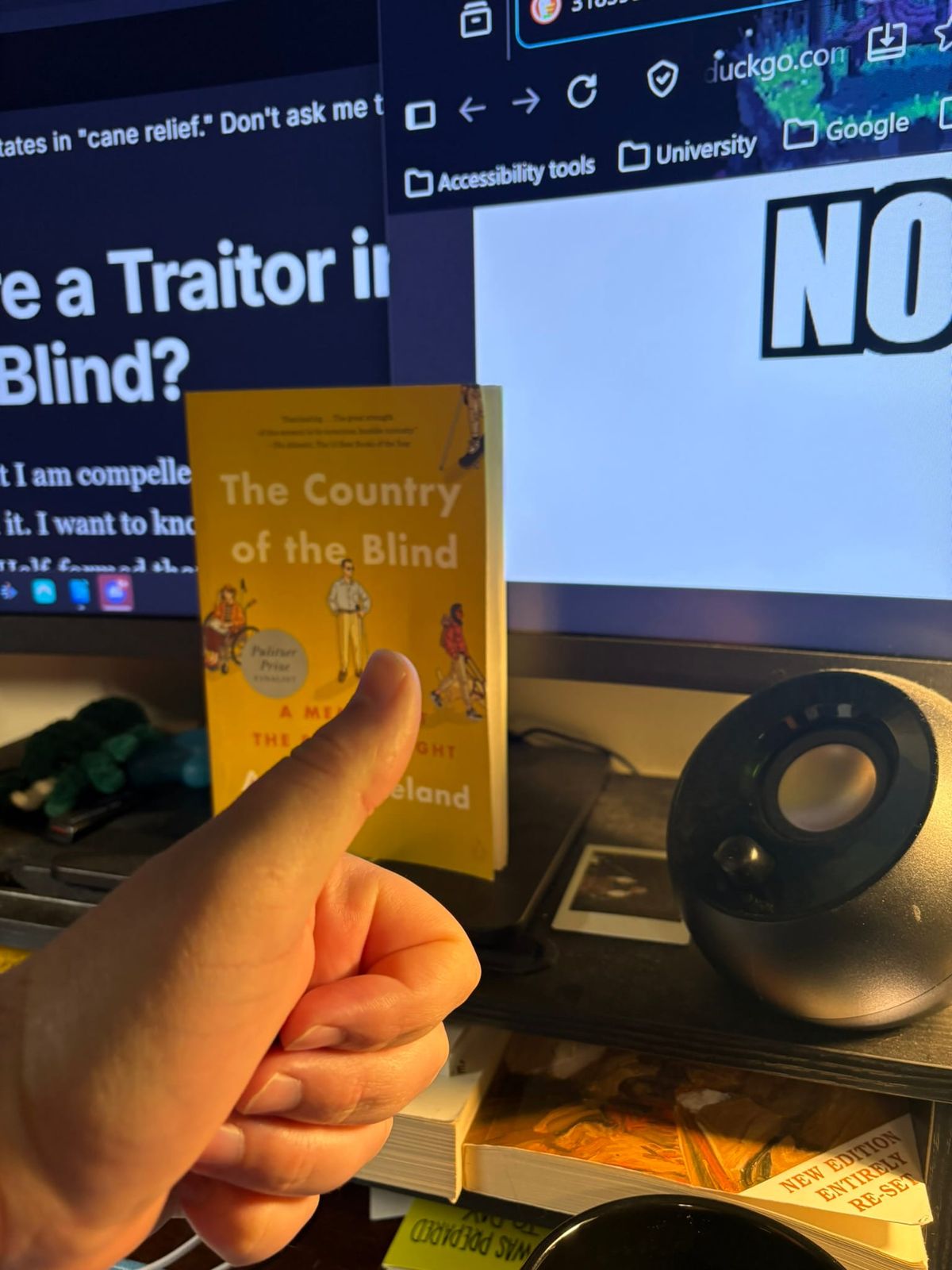
I have made a fool of myself. Sometime ago I made an insinuation that there was a traitor in the country of the Blind. Mostly as an eye-catching title to startle folks into reading, but also as a reaction to my very early thoughts on Andrew Leland’s The Country of the Blind. There is no traitor, there never was a traitor, that’s advertising folks, but I did have qualms with both the opening chapter and some of Andrew’s comments on a tech podcast. I encourage you to read my thought thoughts (see the clever hyperlink above?) because I do still generally believe in said thoughts, but I also have to admit that I have provided a textbook example of why you don’t publicly judge something without fully engaging with it. Andrew Leland’s The Country of the Blind is a great book. I still don’t necessarily think it was for me, but I do think that his experience with RP and my experience with RP align with such precision that if everyone in my life just read the book I would almost never get another question about my blindness again.
I hope Andrew reads this (he follows me on Instagram and I’m going to tag him in the post I make about this) and I want to leave him with compliments so I’m going to drop my complaints here and then butter him up so he’ll chat with me. Andrew loves to bring up how he is in a liminal state of Blindness; it’s a central theme of the entire book and he loves to wax poetic about it. Which, yea, I get it! I’m in that same weird corridor where I feel too sighted for the Blind and far too blind for the sighted. All of my interactions with both groups, like Andrew’s, are coloured with that context. I just got tired of reading the same thoughts about it. His ending finds something of a resolution to the tension and I have some suspicion that maybe Andrew wanted to make sure the ending hit in the way that it does by continually reminding us of his precipitous place in Blindness. I just think we were hit a little too hard with the theme bat.
Alternatively, he could be catering to his intended audience: the pre-disabled. My biggest issue with the book, which is perhaps a critique of my own habits, is that the clear audiences that should be reading this book are, as I said, the pre-disabled and the freshly disabled. I’ve been through almost everything Andrew describes with the only novelty coming from his remarkably poignant critiques of the National Federation of the Blind. Which is fine, those audiences need a book like this and, really, Andrew probably wrote this for himself before anyone else. But I look at the state of disability writing and I see memoirs. And biographies and critical theory and Homer. Cursory searches for Blind authors provides lists that overwhelmingly read, “dead, dead, dead, non-fiction, memoir, biography, autobiography, dead, dead, living (have already read).” The big bad of reading, the publishing industry, wants inspiration porn. They want stories of the heroic cripple doing things that people do everyday to motivate the pre-disabled to do something! They want non-fiction because it automatically gives them a visual confirmation of their diversity initiative and they have a book with a wheelchair user on the cover to point at when they are accused of not publishing disabled writers. All speculation, of course, but the shoe fits.
I can tell when a book is written by someone who isn’t Blind. I have read all the, admittedly great, dead people who were Blind. I don’t want the memoirs that will describe some variety of the life I already live. I want a political thriller (which I’m writing) or a literary fiction romance or a horror novel where no character is disabled because do disabled authors automatically have to include disabled characters? They’re out there, I’m sure, and I’ve read many of them, but I’m serious, search up “blind authors” or “disabled authors.” You’ll find the same names and the same lists. Which, again, can be a critique of my own patience in finding the books I want to read. The publishing industry at large does not control all things literature and there are heaps of independent publishers who lack the funds to advertise like Penguin can, and it takes true effort to find the disabled authors they champion.
But even they have a tendency towards the memoir.
I can not truly ascribe critique to Andrew for writing a book that just isn’t for me, especially when I have recognised that the book isn’t for me. I don’t read a children’s book and complain that the prose isn’t lofty enough for me. I can’t watch pornography and complain when they take their clothes off. But I can elevate these frustrations with Andrew’s intended audience as a general critique of the state of disability publishing. And, really, can I truly complain? I write almost exclusively non-fiction about disability shit and the novel I’m furiously working on features a Blind guy (but in my defence the first book I ever wrote (not published) had almost no disabled characters in it which I really shouldn’t be bragging about but it does prove a very specific point here).
Andrew does address this though as he has done much of the research I should have done for me. In the back of the book he has pages of sources, most of which are the typical disabled memoir, but every so often there is a bit of fiction, or even just a name that I can explore. So, thank you.
My first encounter with Andrew Leland predates his book being placed in my hands by the kind bookseller at Birchbark Books. In 2019 I was at my mom’s house trying to sleep and turned to the tried and true 99% Invisible podcast. Episode 360 – The Universal Page specifically. Roman Mars’ sultry voice often lulled me to sleep and I’m certain the producers give guests notes on how to speak in a soothing tone as I have never heard a guest speak in anything other than the most melodic, calming recitation possible. But Andrew, in trademark 99% cadence, rammed me with the exact anxiety I had been carrying out for two years at that point: my looming inability to interact and engage with my most precious books.
In 2019 I had not accepted my Blindness and had only been accidentally told about it two years prior. I knew I might be going Blind and I certainly had suspicions, but my mother didn’t give me the official results diagnosing me with my great-grandfather’s genetic inheritance for four years. For four years she had a document confirming that my vision was fading and she kept that knowledge from me.
In the two years between my finding out and Andrew jolting me awake with panic I had no experience with the realities of going Blind. I didn’t know Braille, I couldn’t use a cane, I had never met another Blind person, the only thing I did was shove it down and hope for a cure. And then Andrew fucking Leland comes and keeps me up that entire night.
And he writes a good book.
Andrew approaches everything with journalistic tendencies, constantly engaged in dialogues with every quandary that crosses the page. He is not content to just say that Blindness is a spectrum, but needs to poke at every discrete point along the line. He has a source for every claim and I sometimes felt that Andrew held apprehension for not having a source beyond himself for his own experiences. There is not an aspect of Blindness that Andrew has not explored, positive and negative, and he has a tendency to put forth contrasting, and often actively duelling, ideas on equal footing. Which is what makes this such a great book for the newly disabled.
At no point did I ever feel Andrew was trying to ascribe his own authority as the author to any of the ideas he’s presenting. He is always ambivalent and careful to show why everything works. Which is in stark contrast to my own scorched Earth style of critique and response.
When I wrote about Lachi’s book (again, hyperlink above) I mentioned that I just couldn’t stomach the particular diction and tone that she set. She’s great at what she was trying to do, but I couldn’t handle the barrage of intense positivity that bordered on the fetishising. Andrew Pulrang featured my essay about I Identify as Blind on his disability newsletter and had kind things to say about it. I tried to turn my lack of enthusiasm for the tone of the book into a lesson on audience, much as I’ve tried to do here, but I can’t help but feel shame for my thoughts, also much as I’ve expressed here. Critiquing a Blind comrade feels counter-intuitive, disingenuous to our plight and movement and something I admire about Andrew is how he goes about critiquing his comrades.
Towards the end he writes about a Blind woman named Laura Wolk who significantly contributed to the appointment of Supreme Court Justice Amy Coney Barrett and uses her position as a Blind person to advocate for staunch pro-life agendas. If it were me I would linguistically tear her head from her shoulders. The damage that woman has done to our movement is, to me, inexcusable and she stands (ha) alongside Texas Governor Greg Abbott as a traitor to her disabled comrades. Her story does nothing but sicken me and it pains me that she has influence that eclipses my own by indescribable magnitudes. Andrew Leland takes from her story what he wants, presents her timeline in the most neutral of ways, and then on page 247 writes, “I reject the conclusion that Wolk draws from this observation—that because there is value in disabled life, and indeed in all life, abortion should be illegal, and women’s reproductive autonomy must be regulated by the state.”
The revolutionary in me wants to condemn this. Wants to sling shit, as I did for Andrew’s sentiments about generative AI, for this kind of soft rebuttal. But I can’t. Much of Andrew’s rhetorical power comes from his willingness to gracefully engage with all aspects of disability. He has no interest in acting as judge or arbiter for what the disabled landscape should contain and lets the readers settle into whatever cabin on the hill they choose. I can’t say I’ll ever share this approach as my rage defines far too much of my existence to let such perverse evil slip, but I am brought comfort that someone like Andrew Leland is here, and writing, to show that we don’t always have to be angry. A sentiment I tried to communicate in my essay surrounding Lachi as well.
It all puts me in a critical mindset to my own position in our community. What am I? Blind, yea, sure. A teacher? My barren bank account can confirm that. In a position to be a cultural critic and literary commentator? Well, fuck, I don’t know. Lachi wrote a good book that isn’t for me and then Andrew did the same. Is there value in expressing critiques of those works, and, more importantly, does that value eclipse the rhetorical underpinnings of critiquing things that are helpful to the Blind community? Lachi’s blatantly infectious positivity says no, that there is no room for this variety of critical eye here, and Leland’s neutrally journalistic approach gives something of a shrug and a footnote about mild academic disagreement. But the part of me that remembers straining through Gillian Silverman’s critical theory seminar in grad school says yes, there is always a need for that critical eye. That the only way our movement and culture can thrive is with some mild internal resistance. Mild and internal being the keystone concepts in that claim.
Everything should be critiqued at some point or another. It keeps us fresh and embedded in the confidence of our perspective that we need to sustain it. If someone comes to me and says, “Why the fuck are you so negative towards other Blind people you disagree with?” it does me no credit to not know. I need to have a solid reason that often only stems from this critical look at my own writing. Flip this script and you’ll find why I do what I do. Why does Andrew use the tone that he does? Why does Lachi use the tone she does? Why does the publishing industry gravitate towards certain varieties of disabled writing? The critique is not always an attack, even if my own personal rhetoric can sometimes come across that way. Stirring the pot has a counter-productive connotation to it, but how else are we to ensure that the ingredients are integrated into a good stew?
I say we should stir the pot more, but only if we can admit that our own pots will be, and should be, stirred. If not by someone else, than by ourselves.