


Paul Bunyan and Magic the Gathering. Good friend and long-time reader of mine, Edward, knows exactly what is coming, and he probably also expects me to bring up Big Iron.
In 2024, Wizards of the coast released Outlaws of Thunder Junction, an expansion for Magic the Gathering clearly inspired by westerns, Americana, and the folklore and culture it was influenced by and, in turn, influenced. It was fine. Mark Rosewater, head designer of Magic the Gathering, writes about it in his 2024 State of Design and even his retrospective on it culminates with a lukewarm, “Yup” a la Arthur Morgan. Translating the “American Southwest” into a set of trading cards is a monumental task, and the narrative team behind Outlaws did a fine (read hesitantly and with a small stutter) job, but the genre comes with a family value pack of expectations and a posse of histories that are all in conflict and vying for ultimate expression.
This is the backdrop onto which Bonny Pall leads her ox.
Two more points of context before we get to her though. Firstly, while I would not consider myself an expert on Paul Bunyan on the level that folklorists can, I can claim something approaching that expertise. My first book, which lies, deconstructed, in a pile of pieces that may or may not ever see publication, was a retelling of the Paul Bunyan canon of tall tales. For a year I read everything there is to read about Paul paired with everything there is to read about lumberjacks, the American lumber industry, and the folklore those industries produced. Which is to say that I am enough of an expert to provide cogent commentary on a Paul Bunyan pastiche Magic the Gathering card. Secondly, I will be using references to various gameplay mechanics and terminology from Magic the Gathering and its wider cultural community. I am not going to bloat the runtime of this here text for the sake of defining and explaining everything. If you’re familiar, hell yea, if you’re not then know that I will try and provide just enough context for you to keep up, but only that.
Bonny Pall, Clearcutter is a six power, five toughness Legendary Creature – Giant Scout with reach for one green, two blue, and three generic mana. When it enters the battlefield, it creates a blue Token Legendary Creature – Ox named Beau whose power and toughness are equal to the lands you control. Bonny Pall also lets you draw a card and put a land into play from your hand or graveyard each time you attack. Bonny Pall’s art, in clear reference to Paul Bunyan, is a giant woman holding an axe with an equally giant blue ox behind her. They are leading a team of smaller, but still muscularly strapping, axe-wielding folks portrayed, en media res, cutting down a forest of cacti that are shaped to somewhat resemble the tall conifers Paul is often associated with. The Beau token is a close up of the reference ox towering over and eating a grove of those same cacti.
Bryan Sola illustrated Bonny Pall and Loic Canavaggia illustrated the Beau token.
Alright, technical stuff over, let’s boogie.
Outside of the gender swap, this is just Paul Bunyan, complete with axe, ox, beefcakiness, and a penchant for clearing forests. There is no real complication beyond setting, and I would even argue that the setting hasn’t essentially changed. Thunder Junction is a plane with one indigenous intelligent species, Cactusfolk, and everyone else, Bonny Pall included, are colonisers from a different plane. Paul Bunyan, overwhelmingly portrayed as a white man, sprang from European colonisers who initially spread his tall tales in the American Northeast. Big guy comes from Europe to America to cut down a lot of trees = Big woman comes from somewhere else to Thunder Junction to cut down a lot of big cacti.
I can’t help but be disappointed by this. This is not a reference, not even a pastiche, nor would I call it an adaptation. It’s a copy. Play with the story, play with the origin, play with the expression, I don’t care, but why take this foundational tall tale, one that claims origination of heaps of natural landmarks, and do nothing with the potential for interesting interpretations? Maybe I’m missing something, some inked line of flavour text that casts Miss Pall in a light more interesting, but she doesn’t even appear in the story of Thunder Junction. I can find no reference to her outside of a brief mention that she belongs to a faction known for their distance from wider society, which itself is not interesting nor novel enough to carry a character.
This leads me to believe that she is a gameplay-centric inclusion, Thunder Junction’s expression of Simic ramp. Simic, for the purposes of this here report, is a description of a specific “colour” combination of mana, it being blue and green, and ramp is a term used to describe the action of putting a lot of lands (which produce the central resource for playing cards in the game) onto the battlefield.
I have a problem with this, too.
Lands in Magic the Gathering “tap” for mana. The lore of the game generally expresses that magic is being pulled from the landscape and each “colour” of mana has a particular geographical feature that it creates when it is concentrated. Paul Bunyan AND Bonny Pall destroy geography, there is no other way to interpret this. There is maybe some wiggle room in that the creation of a handful of lakes, mountains, and valleys are folklorically attributed to Bunyan, mostly by accident, but Bunyan’s and Bonny’s explicit goal and crowning achievement is the destruction of natural landscapes. Forests being the primary victim. Despite this, Bonny’s gameplay action has her creating and resurrecting forests and islands.
I would mark this as a hidden triumph of narrative design, the key twist that could elevate Bonny Pall from cheap copy to interesting reference, but her mechanics, her ludo, do not match her story, her narrative. To copy a particular trend in gaming criticism, she is a prime example of ludonarrative dissonance. Her story does not match her gameplay.
Can this be explained? Surprisingly, yes. “Land destruction” is a group of mechanics in Magic the Gathering that does exist, but exists under an intense hatred from the player community at large. Since land produces mana, again, the primary resource for playing cards, destroying an opponent’s lands is tantamount to not letting them play the game. People who play “land destruction” cards are usually targeted during the game and then asked to not do that any more outside of the game. Printing Bonny Pall as I think they should have would essentially ensure that she is rarely played and frequently hated.
I don’t have insider information on how and why Bonny Pall was designed the way she was, but I imagine the designers were holding those two needs in mind. A card should be played, and only mildly hated at worst. I am not willing to levy an accusation of laziness against them as I am in no way a talented designer of complex trading cards that need top be cleanly slotted into the context of a game decades old, but I am willing to say that Bonny Pall could be more interesting.
So, below, you will find my take on Bonny Pall.
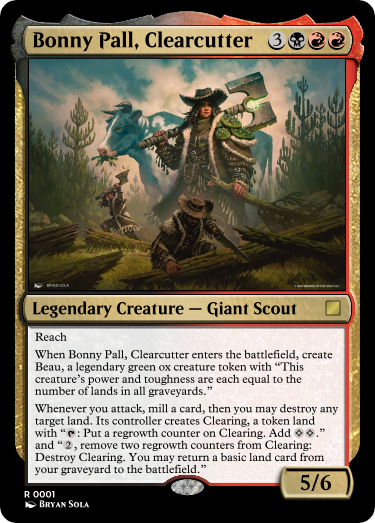
You will find heaps of similarities. Bonny still creates an ox, still cares about lands, and has the same numbers attached to the various boxes. But the ox is no longer blue, it is green, and instead of caring about lands that are on the battlefield, it cares about lands that are in graveyards. Almost as though it has eaten them to gain strength. Bonny now destroys lands instead of resurrecting or summoning them, with the small downside of having to mill (put into the graveyard) a card from your library. But the destroyed land is replaced with a temporary land that taps for colourless mana, a mechanic typically associated with man-made constructs and landscapes, and it has the ability to regrow into a natural form later on. A reminder both in and out of the game that our destroyed ecosystems can be regenerated with patience, time, and care. Note, also, the shift in colours. Blue and green typically don’t destroy land, but red and black do. Bonny Pall is not a nature-loving, cactus-hugging hippie, but an impassioned industrialist here to ensure her band of cronies can colonise without holding space for the empathy that should be extended to the landscape and its indigenous inhabitants. The ox is green because he’s just an animal. He is fed what he is fed. I also swapped the power and toughness, going from a 6/5 to a 5/6. I feel like Bonny Pall, giant and axe-wielding as she is, is capable of taking hits, but is used to her targets falling with ease, leading to a laziness in her offensive capabilities.
Is the card perfect? Probably not, but I am going to post it around and get some feedback from the wider Magic community. I might pop in and update the post with those findings, or make a new write up. We’ll see. But I do think it makes for a more interesting interpretation of Paul Bunyan, ironically by interpreting him with even more accurately. Seldom is it that Mister Bunyan is presented as anything approaching antagonistic, and his actions are certainly never construed as being destructive. My Bonny Pall remains a true adaptation, she is doing essentially the same thing in essentially the same scenario, but the twist is that Rakdos (black/red) Bonny Pall isn’t interpreted through the lens of lumber industry propaganda. She is true to her mission, the destruction of the landscape for the sake of enabling industrialising colonisation.
I do like the Bonny Pall, Clearcutter card as it exists. I own two copies, a borderless foil and normal printing, and have a Simic deck that she commands. Though, taking a step back, I have to admit that my love for Bonny Pall doesn’t stem from an appreciation of the adaptation, I think I made that clear, but from my own personal history being entwined with Paul Bunyan for such a long, emotionally pivotal moment in my academic career. A wrote a fucking book based on him! Released, published, finished, or not, I am proud of my work, and Paul Bunyan chopped the trees in my dreams every night for months as I wrote him into a role that is fairly comparable to my version of the Magic card.
I don’t necessarily want to spend my conclusion spinning off into a soliloquy about artefacts of our appreciation being more complex than a binary “good/bad” in any given framework. But I can’t help but use this whole process as a showcase of how we can fundamentally disagree with the existence of something while still loving it.
I do want to end with words on adaptation though. Adapting culture is tough, and that’s exactly what Wizards of the Coast set out to do with Outlaws of Thunder Junction and Bonny Pall, Clearcutter. The culture of the American Southwest is neither simple nor history. It spans heaps of misinterpretations, revisions, and conquests while still being an evolving, breathing existence to millions of people. How is anyone supposed to accurately translate the singing cowboys of the 20th century alongside the revisionist films of the 21st century? How is anyone supposed to respectfully capture a landscape that was stolen from its stewards, then stolen AGAIN from the oppressed folks who fled there to escape other oppressions? You can not have a giant like Bonny Pall slashing down saguaro cactus without also reconciling the atrocities enacted upon Mexico so that the white man can put on a hat and say, “Yeehaw” while strutting around an arena. You can not adapt the Southwest while wilfully ignoring the line of dead bodies withering in the desert who are there mostly because the northern monarch of said border prefers them to be corpses.
This may read as a sudden political expression, but all texts are political and texts about the American Southwest are especially political. Mark Rosewater, the head designer from earlier, admitted in that essay that players were frustrated at the lack of seriousness Wizards of the Coast afforded the setting. Outlaws of Thunder Junction is, indeed, more singing cowboy, Red Dead Redemption, 1969 True Grit, than it is compelling adaptation of a cultural geography. Made all the more insulting by the unexplored inclusion of an indigenous population of Cactusfolk.
Set on this stage, Bonny Pall is small potatoes. The problem is that everything in Outlaws of Thunder Junction feels small potatoes. There are heavy, imposing themes to be explored here, with plenty of room for whimsy, yes, but also a necessity of reverence that is painfully absent. I hope Wizards of the Coast returns to Thunder Junction in the future, and I especially hope that the lukewarm reception of the set isn’t being read as a lack of interest, but as a deficiency in their own design. I hope we see the Cactusfolk take a stand against their inter-planar colonisers. I hope we see figures like Bonny Pall cast in a more complicated, interesting light. I hope we see a singing cowboy alongside Dutch van der Linde, and that tension taken seriously and expressed intelligently.
And for fuck’s sake, I hope we see a card that says “Big Iron” and is a Legendary Artefact – Equipment and it’s just a really big fucking gun being shot by one of the aforementioned singing cowboys.


