


Chicago! Is everyone there always cold? The week I was there was hot, stinkingly sweltering, with the titular wind being more akin to a hairdryer than the chill breeze I associate with my home’s Great Lake A/C. And yet, there were coats everywhere! I regretted the few times I wore pants past my knees and suffered through a stylish expedition into a long sleeve, but the locals were decorated in puffer jackets, coats, boots, gloves, scarves. Are y’all okay? The city itself seemed to pump heat from the various vents and orifices in the street and yet y’all walked around as if the Northern Wind was smashing sheets of ice into your chest.
I liked Chicago well enough to consider it my favourite of the “big boys” of the United States, the others being Los Angeles, New York City, and arguably San Francisco. It’s pretty, it’s got nice features, there’s heaps to do and on and on. But the L, oh my lord the L. I feel a great shame that I associated the L’s iconography with New York for the better half of my life thanks to Sam Raimi’s Spider-Man. If I could spend a week just getting on and off that train, I would. The trains are frequent, the stops ubiquitous, the announcements (generally) clear, the system easy to navigate. Even the fucking app works! Transit apps never work, and yet Chicago figured it out. I love the L, Chicago clearly loves the L, and everyone should love the L. That transit system should be the baseline quality of all transit systems worldwide and every city that claims to have a public transit system should be disappointed if it is not at least as good as the L. And while I think it should be free, as all public transit should be free, two and a half American dollars is not bad, but they shouldn’t be charging five dollars for trips from the airport.
I have a naiveté in my bones that leads me to think I will someday travel to a city with no ableism. The trains will run on time and the infrastructure is designed with the best accessibility principles held aloft as everyone from the cripple to the child will be free to access the city in all its glory. Chicago was not immune from the stubborn optimistic funny bone wedged in my angry skeleton and my virgin trips on the L had that bone wiggling in its confinement.
Then I came to discover that most intersections don’t have audible cross walk buttons. That a significant amount of crossings were built without curb cuts. That the street signs down town are fucking microscopic. And the people driving cars in Chicago are some of the most inconsiderate, rude pieces of shit I have ever encountered. Within two hours of my being in Chicago for the first time I was already beating someone’s car with my cane, not because I was particularly angry at them, but because they were in the middle of a fucking cross walk during a red light and I had to navigate fully into oncoming traffic to get around their fuck-ass SUV. This happened at least once per solar cycle. As much as I praise the Ventra app for working, CTA clearly has no intention of using it to pass along critical closures and detours to riders as the Pink and Green lines had major detours in effect that were only communicated via sign and the occasional, and I do mean occasional, overhead announcement. These closures and detours had been in effect for days prior to my arrival and yet there was no alert on the app that I could find and I only found out about said detours when I happened to ask a CTA employee after waiting far too long for a train. She was kind, but god damn it’s clear she’s never given directions to a Blind person.
Now, the L is great, yes, but the stations the L services? Those range from acceptable to offensive. I can handle dated, and they are dated, but I can not handle labyrinthian and seemingly in competition with each other to be as inaccessible as legally possible. Lifts are often tucked in corners or inside buildings that seemingly have no association with the stop itself, and getting around a station as a wheelchair user must be a task only given to those with the best anger management professionals on retainer. The twisting, airborne corridors of stairs and bridges and halls and stairs make no sense and are clarified only partially by contradictory signage placed haphazardly by a man from Dingle who was hired because his taste in glue was divine. The gates that enforce the two buck-fifty tribute are impossibly narrow and only a select few stations had accessible turnstiles, which weren’t even much wider than the normal ones.
My time in Chicago was limited, and my anecdotal experiences are vastly undervalued compared to my fellow Chicagoan cripples, but I do find it telling that I encounters not a single other disabled person at any point on the trains. Canes, chairs, crutches – all notably absent from my various commutes. Even in Duluth, MN, a city with a far less hospitable transit service, I frequently encounter wheelchair users on the buses. Much of this can be attributed to my limited time, but when even out walking the streets of various neighbourhoods I was the lone disabled person to be seen. The one other cripple to catch my eye was at the Movements concert and she gave me a very pretty, flowy finger wave from a bright orange chair.
I still feel maybe we were alone together in Chicago.
Which is a reminder, particularly cruel, to that naive bone that it is, indeed, naive and not just optimistic. The ableism we confront is not tied to geography, but culture, and our cultures are mono enough to sustain that ableism everywhere. It shouldn’t disappoint me.
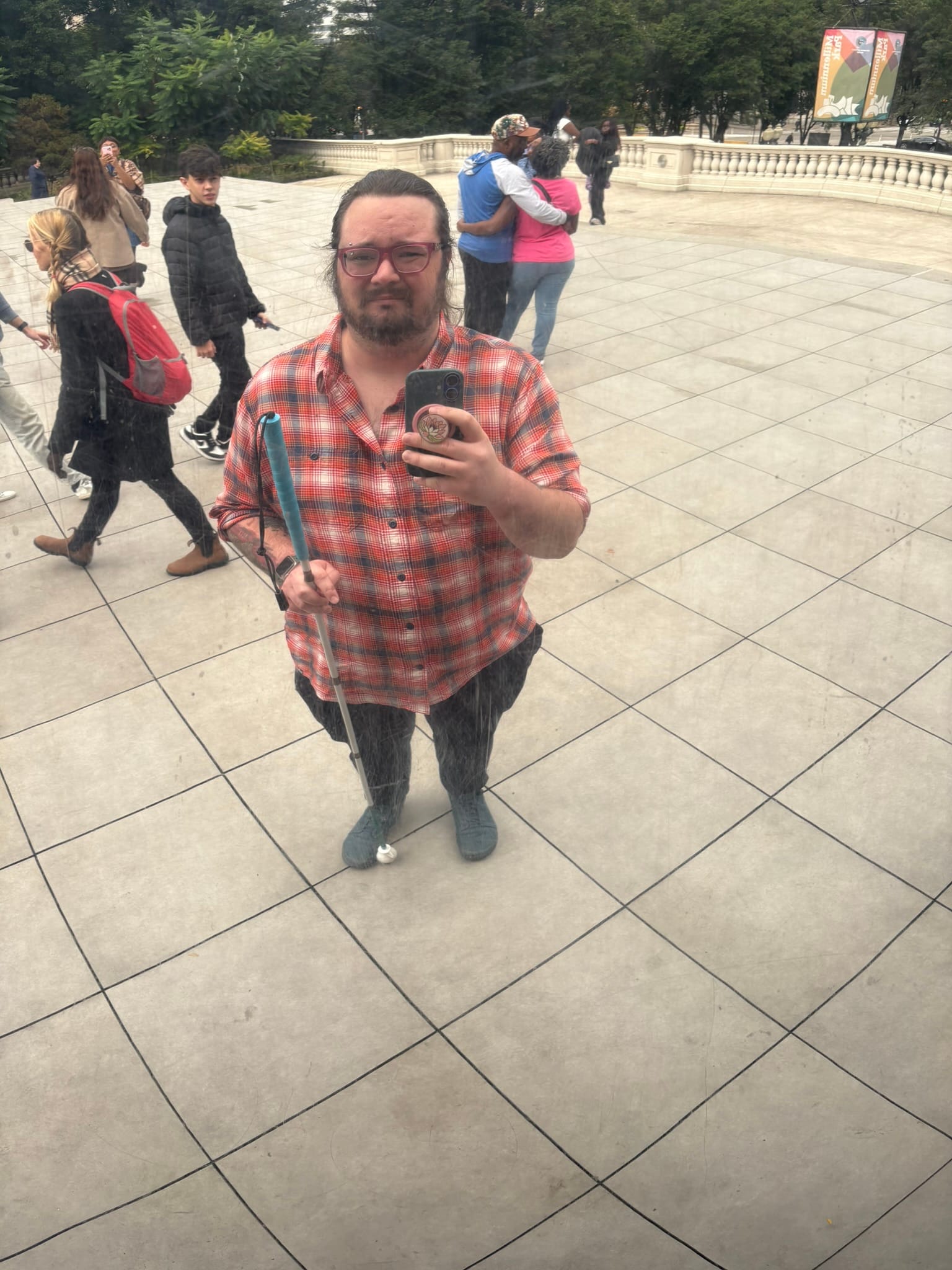
I went to Chicago primarily to attend two concerts, Hey, Nothing and Movements, but I did play the tourist a bit given how much sheer stuff there is to do in Chicago. The Bean has a ramp and is an interesting touch, but as indicated by the ring lights and tripods and expensive cameras it is a visual spectacle more so than anything. But the tiles it sits on are hollow, or at least covering some kind of faceted cavern, and my cane rolling and tapping over them gave the impression that the Bean, and all of the humans flicking it, could fall into a subterranean enclosure where our biomass can be fed into the titular legume guarding its feeding ground. Or maybe the tiles are a particular fired clay that are individually hollow, creating a cavern in collection instead of hiding a true cave.
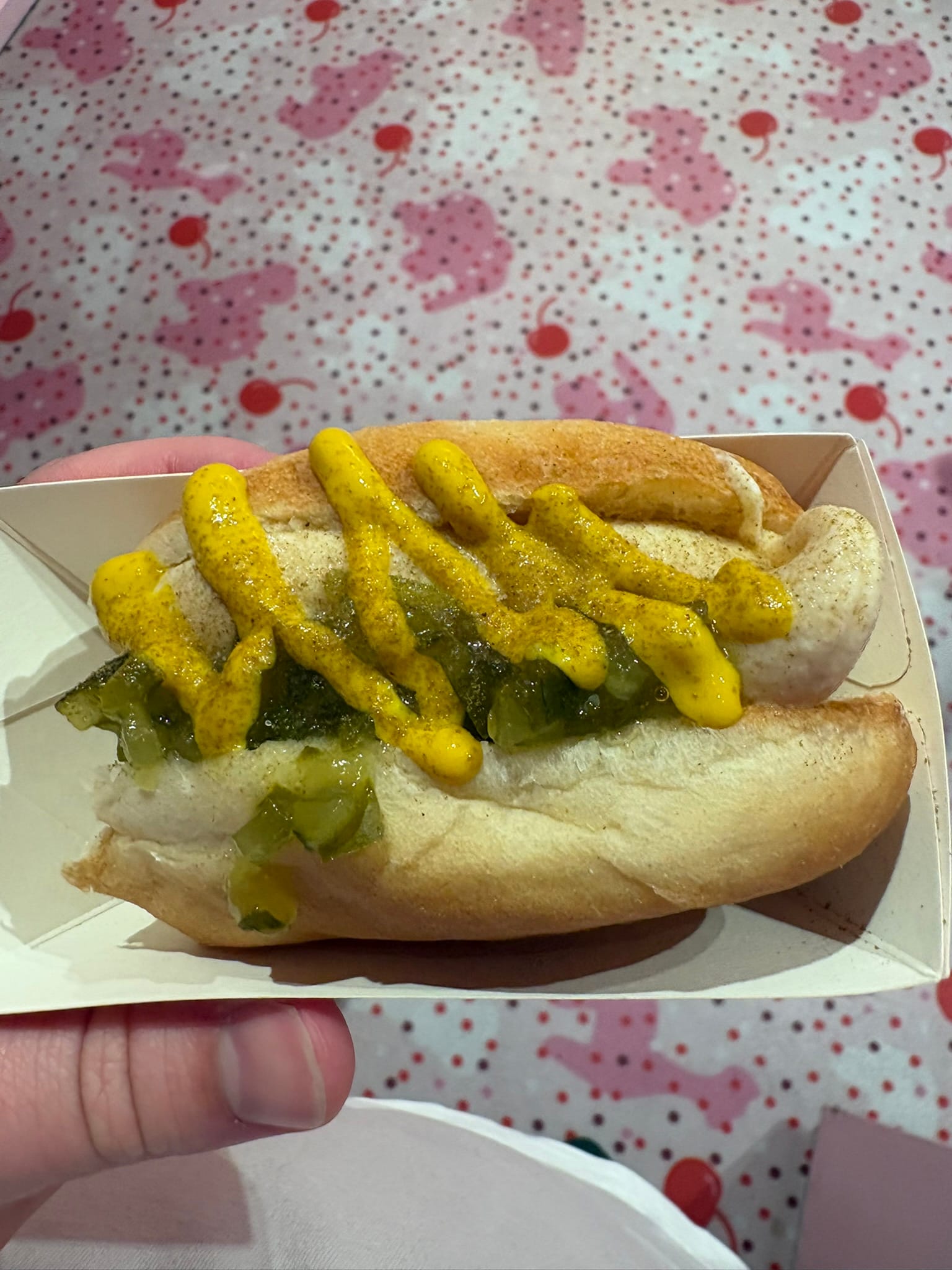
The Museum of Ice Cream sucks. It is a tourist trap by all definitions, many people have said this on the internet but I will forever be drawn to any institution that advertises a non-visual experience. The ice cream was good, the hot dog flavoured one distinctly excluded, but it is ruined by masses of children and a price tag that overwhelms the overall offering. Hide tubs of ice cream in various rooms of your house then just walk around your house for an hour and you’ll have an experience that eclipses that of the Museum of Ice Cream.
The Field Museum is a Blind person’s nightmare. Dark, twisting, small text, and exhibits that are to be seen and, well, seen. There are a few touchy-feely bits and those can be a joy, but the Field Museum follows most other museums and assumes that anyone who is touching something in a museum is below the puberty line. The map of Tenochtitlan being a memorable exception to this rule. I touched the shit out of that thing. Oh, and the Pokemon popup was cool and had a few touchables. On the bottoms of the website’s “Accessibility” section there is a guide on various multi-sensory aspects of the museum, which is nice and the list does accurately portray those aspects, but it’s something that’s been stapled on. The museum did not create these sensory experiences for people, they just went through and counted what is already inherently non-visual. Like, yes, all of the videos are “accessible” because they feature someone speaking. This is not something to celebrate as an achievement in accessibility. It’s also important to note that this map, and any information regarding accessibility and multi-sensory experiences, were not drawn to my attention by any of the multiple staff I interacted with. A critique that, I admit, I feel slightly uncomfortable making for is it truly their responsibility to educate me on the accessibility of their museum? But then I think, yea, it is! I have a cane, I’m visibly disabled, anyone of those people could have at least offered. Part of accessibility isn’t just having the PDF buried in your website, but also having staff/docents that are trained to say, “Hello! Would you like instructions on how to access a map featuring our multi-sensory exhibits?”

Again, I shouldn’t be disappointed by the unfulfilled potential museums have as multi-sensory spaces. Preservation is important, but tactile replicas and trained docents shouldn’t be as rare and exclusive as they are. All of my glowing recommendations for places like the Field Museum, because I do recommend it, come with the distinct subtext that they’ll be heartily enjoyed by the per-disabled. Particularly the sighted. I love the concept of the Field Museum. I love the vibe of the Field Museum. I love what was described to me within the Field Museum. I want to go back and experience more of the Field Museum. But fundamentally, I hate the Field Museum. Bastions of culture and education are roped off for the normate.
I am not, as my mother insists, only doom and gloom.
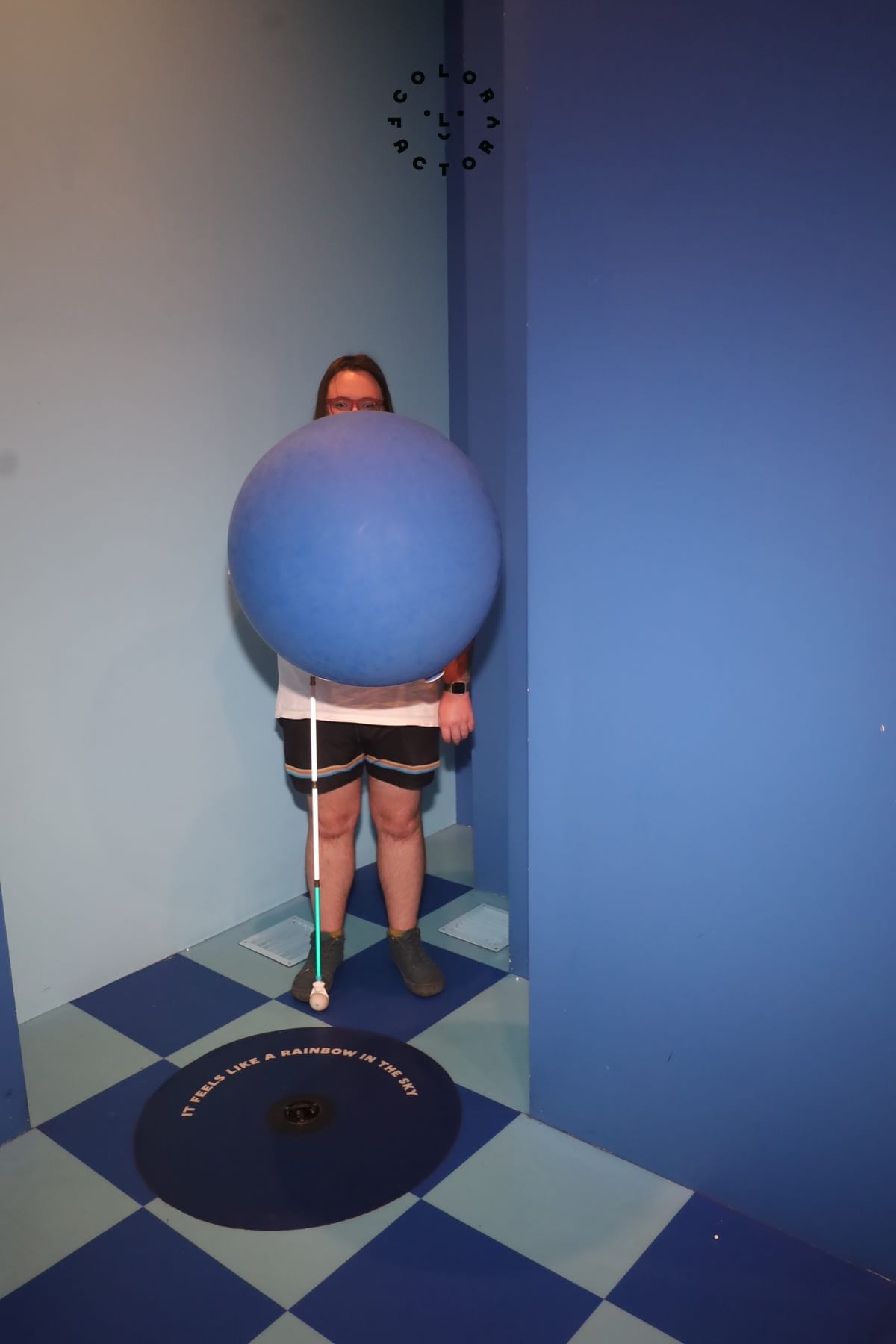
In the basement of Sears Tower lies an art installation called The Color Factory. An initial probe would suggest that something based on the premise of colour would be horribly inaccessible to the Blind, but there is no truth to that first impression. Nearly every room is a kaleidoscope of sensory experiences. Yes, there are bits and bobs that are for looking, but everything in there invited touch and it was always fun to touch. Several rooms had participants eating little treats and ruminating over how taste changes with other inputs. Three entire walls were dedicated to pumping out the olfactory representations of Chicago culture and at one point I was assaulted by balloons held aloft by jets of air blasting from the floor. It is trendy, yes, it is founded on an idea of social media propagation (with every guest receiving a QR code on card stock to scan at cameras in each room allowing it to send the photos right to your email), and yes, there is a pervasive childishness to many of the non-visual elements involved. But as a baseline for what can be done it is brilliant. Not quite as immersive as something like Meow Wolf, but magnitudes more physically accessible. Not as cultured as an art museum, but heaps more fun. Again, like the L, if we considering something like Color Factory to be a baseline ripe with potential for iteration and expansion, and not just a novelty in the bottom of a tower with distinct nomenclature clashes, then we can start making progress into developing installations that reflect the actual diversity in our cultures and societies.
The American Writers Museum. I’m a biased little baby bitch, yes, but fuck me if that wasn’t the best museum, I’ve ever been to. The first thing that was said to me by the docent at the front desk was that I should touch everything. And touch everything I did. Not just as a novelty, but as a foundation to the experience of the museum. Everything begged and needed to be touched. Each exhibit was a love-starved nymphomaniac tortured by the time between one visitor’s exploration and the next’s. Writing, tactility, and wokeness all expressed in a narrative spatial voyage that took me from pre-colonial America to the cutting edge of American literary culture? Yea, I’ll get in the van, and you have my full consent for whatever happens in the back for your U-Haul stranger! I hesitate to describe the museum further and I shall listen to said hesitation and instead urge you, dear reader, to visit. Pleasure Chicago’s prime cultural institution and replace her whimpering pleas with shrieks of ecstasy as you experience your own ability to finally be free from the vanilla shackles of your putrid eyes.
Did you know that Zohran Mamdani follows Hey, Nothing on Instagram? I don’t want to legitimise nor entertain the idea that someone of influence following an artist makes them more legitimate or entertaining, but it was somewhat surprising for me to realise how popular Hey, Nothing is. Not because I think they’re undeserving, but I always figured they were the small(ish) punk-folk band right at the dawn of their exceptionally promising career. The inner hipster in me wished to be expressed and wanted to assume that “trans folk-punk” wasn’t something that had fallen into the lap of the cultural zeitgeist yet. But it has, and Hey, Nothing played a show that rivals that of any I’ve ever attended and, honestly, downright eclipses most of them. Their music is, well, queer and folky and punky, and hits the contradicting drums I’ve been forced to carry as my personal culture. There are few things that being me joy like the knowledge that a band like Hey, Nothing has a such a stage. Queerness is a cornerstone of both punk and folk, but a small, yet persistent, section of those communities would wish to see it erased from the cultures that queerness helped birth. Hey, Nothing is a band that expresses the resistance to that erasure with nothing short of manic energy and soulful writing that strikes the heart of what folk-punk should be. You need to attend one of their shows, either in a city near you or not. Travel half the world over just for them and you will not be disappointed.
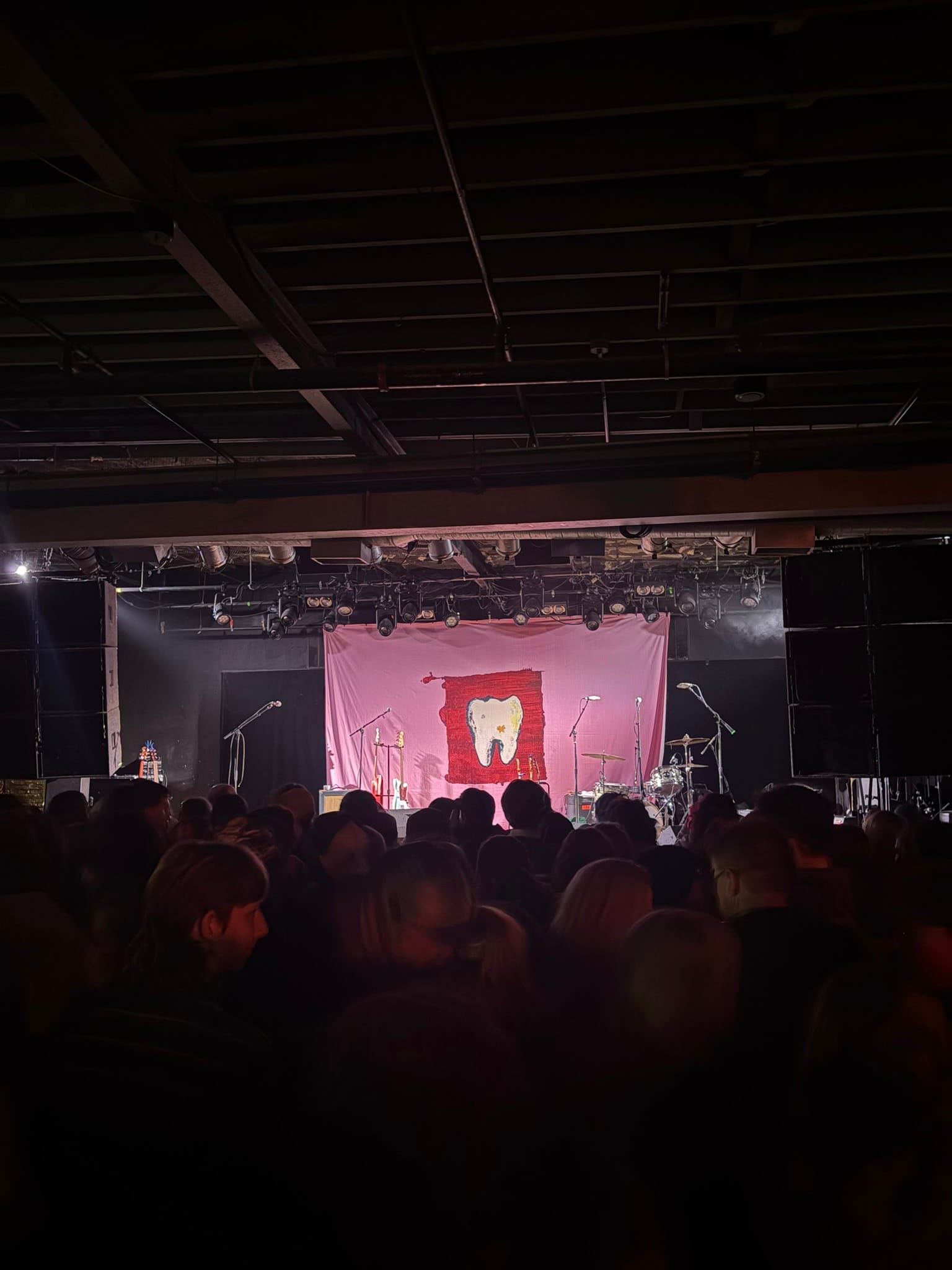
Oh, hey, Movements is here, too! This is the band that initially prompted my invitation to Chicago. If 40% of the reason I went was the L, then 60% was Movements. Hey, Nothing tickets came after when I discovered they were playing in the same time frame. Movements is the perfect evolution of the emo and punk genres that have grown up in a system where the anxieties of the 90s and early 2000s are now baked and blasted into solidified societal conditions. There are still undertones of bombs and war machines in Movements, but those are layered under humanistic reactions to decades of experiencing it. Which isn’t to say Movements is a post-punk emo band dedicated to the sole lyrical protest of war, that’s reductive and not even close to true. They’re more interested in exploring anxiety, broadly speaking. The anxiety of not fitting in, of not being happy, of having an unhappy partner, of being close to someone, of giving up. You’ve perhaps seen trendy post of songs that inspire you to “cry at the club.” Movements is a band that inspires you to cry in the pit. I don’t mosh, my blindness puts me off from it, but my guts do, and they cry in their digestive mosh pit as I stand to the side and cry with the mosh pit always threatening to suck me in.
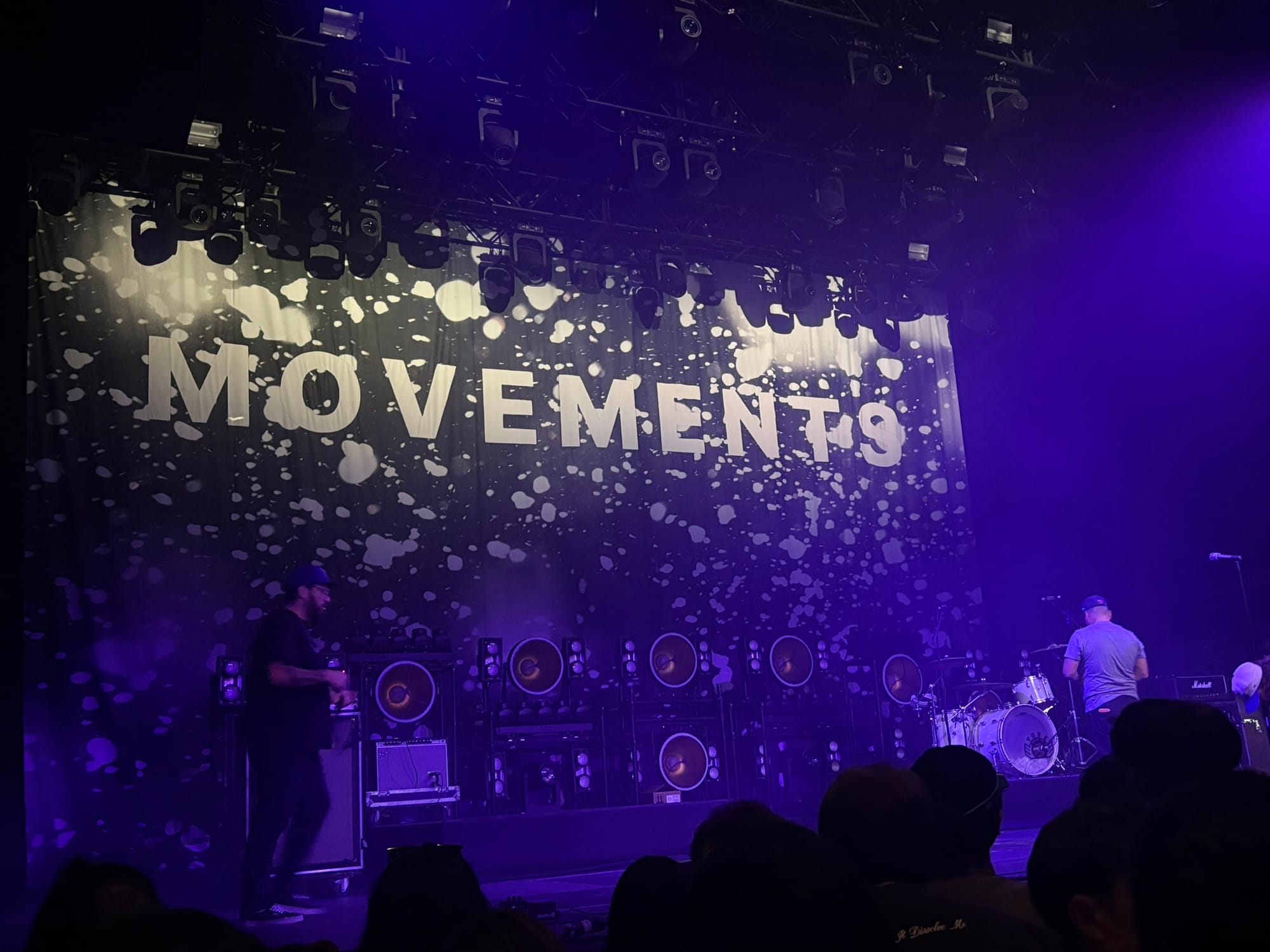
I talk little of the opening acts not out of little appreciation, but little exposure. Crisis Crew opened for Hey, Nothing and gained a fan, but I’ve explored very little of their immense depth. They had a soulful, bluesy drawl that sent me reeling and I’m glad I bought one of their shirts.
Movements went, as the kids say, ham on their opening slots. Niis, Midrift, and Balance and Composure all lent their talent to the sonic built-up to Movements. Niis was not my scene, people doing scary things to their throats and guitars gives me anxiety, but I love seeing a woman with (I was told) incredibly sexy hipbones dominate in a field stereotypically filled with usually racist men. Midrift’s members had just graduated high school and if it weren’t for the fact that I was recently fired as a college instructor (at the time of writing) AND that they’re from the Bay Area I would expect to see them in my class next semester. I won’t say they’re children, that’s insulting, but I will say they have the potential that is unique to the emerging youth. Easily wasted, but spontaneously powerful. I hope they utilise it well. Balance and Composure were cool. Patrick Miranda cited them as an inspiration for Movements and, in a true “who is the master now” moment, noted how they used to open for balance back in the day. I can hear the building blocks, and I don’t mean this as anything resembling an insult, but it’s clear that Movements is an evolution of the groundwork Balance and Composure created, which itself is an evolution of earlier post-punk, new wave emo, soft grunge so on and so on. It’s fun watching those evolutions share a stage when the components that are being borrowed and copied and iterated upon are so clearly on display.
This is not the first time I have travelled a great distance for art. TWRP notably drew me to Burlington, Vermont (one of my favourite American cities) and I’d be lying if I said I wasn’t tempted to irresponsibly travel to Dublin to catch Kneecap live. Even when I’ve stayed “home” for performances, the crowd will be full of folks who have crossed multiple states or oceans for the sole purpose of seeing a show with city tourism being a lovely side effect of their trip’s prime directive. It is unreliably reported that concert attendance is at an all time low, but anecdotally I can’t believe that statistic. The concerts I attend are packed, jammed, and sweltering with bodies desperate to be there. Hey, Nothing – sold out. Movements – sold out. TWRP – sold out or damn near it every time I’ve seen them. It could be that my taste in music approaches the divine. Or it could be that people aren’t willing to shell out hundreds to thousands of dollars to see someone from the top 10 Spotify charts in a stadium. Movements was the most expensive show at thirty-seven United States dollars and some change. Four bands for less than forty dollars. Hey, Nothing was twenty-seven dollars and some change. Scouring my memory, the only show I have attended recently that was around $100 was Ben Folds and even then I don’t think it was quite that much. People want to see shows, and they will travel to them, but I think they’re seeing “smaller” bands.
Now, as fuel prices rise and everyone’s wallet tightens, the travelling will take a dip. If I’d known I was going to lose my job when I booked this trip several months ago, I probably would have approached the whole thing with a bit more caution. We’re edging into an economy where younger folks are starting to cut back on physical goods and replacing those lines in their budgets with experiences. This is an unsubstantiated claim, as many of my claims are, but I do think there is a shift in priority happening as money becomes more precious as we approach the 2030s.
A travel writer I am not, even if the idea has been pitched to me by a few people many times. Hopping around and testing the accessibility of various cities sounds fun, but it’s ultimately a shallow representation as only the locals can fully speak to an immersion in the local blend of ableism. Travelling to Chicago for four days does not bequeath upon me the authority to comment on “the disabled experience” it offers. I’d need to live somewhere, navigate their particular flavour of bureaucracy, shop at the grocery stores, interact with the people, before I could ever form anything resembling a coherent opinion on the accessibility of a city. Even as a tourist my words hold little weight. I can notice elevators and ramps, but I could not even begin to accurately commend nor damn how a wheelchair user would fare. I daresay that there is no true “disability travel writer” as there is no true universal disability. Even within my own bubble there is such a diversity in blindness that some folks may laugh at my ineptitude while others are scared away by the mere mention of multiple train lines that are named after colours (which is an odd choice considering how common colour-blindness is).
Really I wrote this for more specific and selfish reasons. While walking around, I thought of two lines, “Chicago! Are y’all just cold?” and the bit about being naive. Those stuck and I wanted to spin them into something with some meat. I’m also fundamentally lazy. Inevitably I will have friends who will send a well-meaning and genuine text asking some variation of, “How was Chicago?” and I will not want to type the same general thing, with a few personalised tweaks that change from person to person, more than once. So now, when someone asks how Chicago treated me, I will send them this link! Some of them may even be subscribed to my quaint little site here and not need to ask me. Which actually does make me sad as I would love to talk to my friends about Chicago, just maybe not the broad strokes over and over again. Let the generalisations be mass-produced and distributed so that each person can approach me with the specifics that matter to them.
I refuse to sentimentalise “travel” as a concept as that has been stereotyped to death and there is a certain amount of classism embedded in the idea that just rubs me the wrong way. We’ve all collectively been told that travelling is a sure way to acquire “culture” and that a life without travel is borderline dreary and useless. But travelling is expensive. I’ve only been able to because my dad died and left me some cash. There are uncountable amounts of people that will never leave their place of birth, even more that won’t leave the country, state, providence, or street of their birth. Romanticising travel and the alleged culture that comes with it is a form a commodifying culture and distributing cultural worthiness only upon people who have the means to travel.
When I first was told I was going blind, I was told to travel as much as possible, to see everything I could before I couldn’t see any more. Being more firmly established in my Blindness I now know that was a load of shit. Blind folks can travel just as well as anyone else, especially when given the tools and experience to do so. Instead of encouraging teenage me to travel, I should have been encouraged to go to a school for the blind and learn how to independently navigate novel places.
I look at this combination of cultural commodification and aggrandising we’ve afford travel and can’t help but think of my own privilege. I was privileged enough to buy into those systems of thought for years and there are influential folks out there who are touting these platitudes without a shred of self-awareness at what they are propagating. I’m grateful that I get to take some of the trips that I do, but I’m also trying to be careful in not assigning them too much significance. Travelling alone does not bequeath anything inherently. I could get up, out of this chair, and buy a ticket on some plane to Bangladesh and spend a month there and then sit in a hotel room. Eat room service. Speak only to hotel employees and drink bottled water. I have travelled! and gained nothing. I’ll see these videos of influencers going to Bali, Mexico, Puerto Rico, Florida, Australia, or any other vaguely coastal region and then lounge at the beach and then talk about culture. As if an entire culture can be found on a single beach. What has been gained from that besides a tan and some effective thirst traps?
I equally can’t stand the breed of fetishisation that Anthony Bourdain has popularised as well. Where travel is only worthwhile if you get your hands dirty and explore the underbelly of a city. Living wild and rough for a week and then going home with the consequences. Sure, that’s better than the beach, but what have you gained?
I have no conclusion to this beyond my gratitude that I am able to generally experience what I want to when I leave my home. I seek out what I want, feel good about it, and then come home. I don’t pretend that any of my trips have made me a better person when I have been remarkably unchanged by the vast majority of them. If there is some kind of conclusion it’s that I am tired of everything being commodified. That the only way to acquire culture or knowledge or wisdom is to engage with a monetary transaction in some way. Yes, I gained knowledge of Chicago in Chicago, but I didn’t have to go there to do so. There are cripples in Chicago that could have told me all of this and Movements would be just as cool in Minneapolis as they were in the Windy City.
But I am excited to share a portion of my experiences with friends and strangers and followers as something like this, I hope, combats the commodification of culture. You now have access to it! For, something resembling, free! And you never have to worry about needing to go to Chicago to get it.


